
Landmines & Lifers

Getting up at 5 am to see how many different bird species you can see might not be everyone’s idea of a thrilling morning. But what if you add the risk of stepping on a landmine? Sound like an adventure yet?

Many expats in South Korea will attest that Koreans can be sticklers for rules, and that safety regulations in public spaces sometimes verge on the ridiculous. That’s exactly what I thought when I saw a sign on the fence saying: NO ENTRY—EXPLOSIVES, and I dismissed the warnings as a classic example of Korean overprotectiveness. Granted, North and South Korea are technically still at war, and it is estimated that there are over a million landmines in the Demilitarized Zone (DMZ) separating the countries. But could there really be a risk of stepping on a Korean war-era landmine in the Greater Seoul Metropolitan area? Turns out, there could very well be.
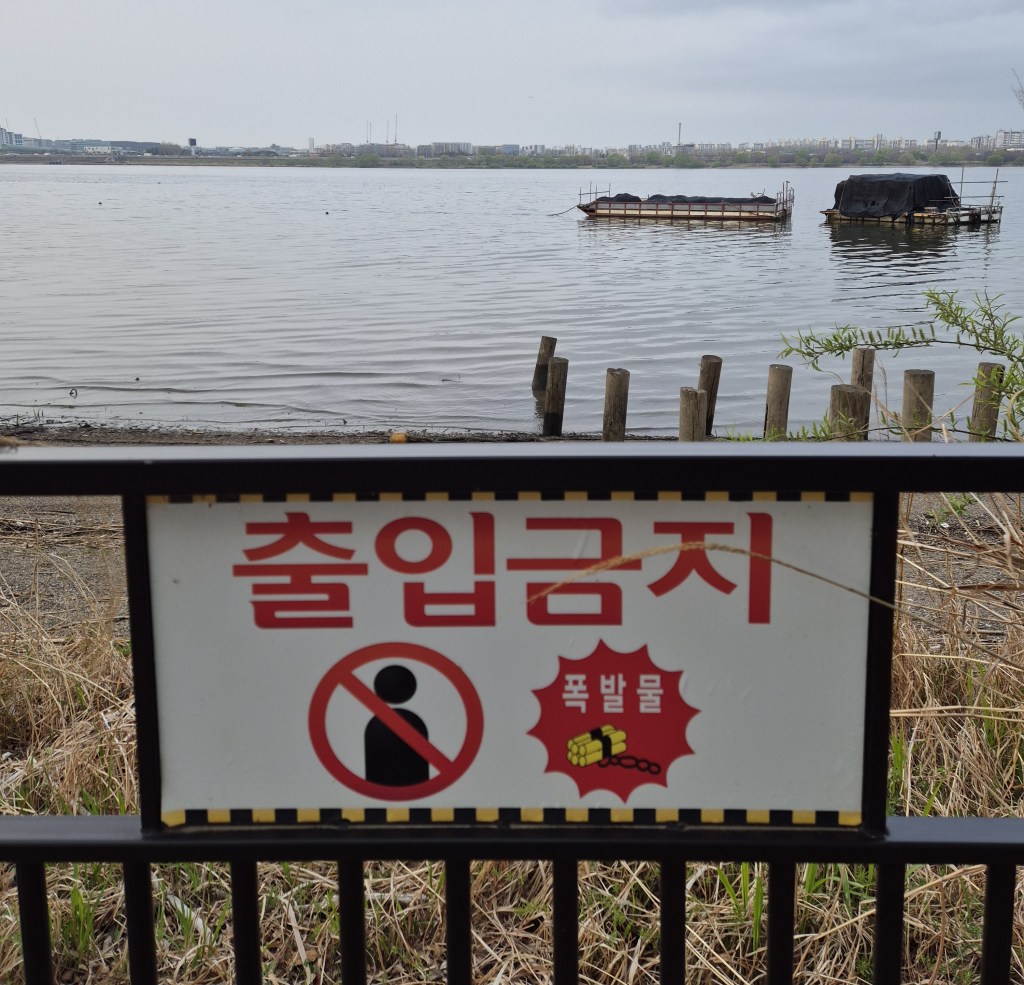
No Entry: Explosives
A sign next to the Han River reads: NO ENTRY: EXPLOSIVES.

Birdwatching Along the Han River

The Goyang Daedok Eco Park (고양대덕생태공원) on the Han River in Goyang-si, just West of Seoul, is well known among local bird watchers for its biodiversity. And the birdlife did not disappoint when I visited the park early one April morning. Among the regular eurasian magpies, large-billed crows, and grey herons that most would recognize, I also saw a few birds you wouldn’t normally associate with the bustling metropolis. Shortly after sunrise, I trekked down a narrow, muddy trail leading to a floating barge tied up next to the shore. The trail is cordoned off with rope barriers and warning signs instructing visitors not to leave the designated path. To my right, I spot a common kestrel hanging roughly 5m in the air, flapping his wings to stay in place as he surveys the reedbed below for any sign of breakfast. Further off, behind the reeds, I hear the squawking call of a ring-necked pheasant—a sound I associate more with rural farmlands than the landscaped urban parks along the Han River.

I explored the parks’ meandering trails and picnic spots, ticking off veinous-throated parrotbills, a great spotted woodpecker, and picking out a northern shoveler among a flock of mallards. I even added one lifer* to my list—a great crested grebe. Most ordinary observers might mistake this waterbird for a duck, if not for its long neck, pointed beak, and punk rock hairstyle. All in all, I logged 23 bird species—not at all bad for two hours of birdwatching in one of the biggest cities in Asia. So what’s with all the explosive warnings?

Landmines Along Seoul’s Waterways

When I got home and sat down for breakfast and coffee, I looked up some Korean news articles to see how dangerous my morning excursion really was. It turns out that over the last five years, there have been at least two dangerous incidents involving landmines along the Han River.

In 2020, a 70-year-old fisherman was injured when a landmine exploded under his camping chair. The incident occurred further down the river, near Gimpo Bridge, in an area that was first opened to the public in 2014. Fortunately, the man’s injuries were not too serious, and he made a full recovery. Following this accident, the Korean military launched a large-scale operation to remove landmines along the Han River. During this operation, two M14 personnel mines were recovered from the Daedok Eco Park area. M14 mines are lightweight, and according to experts in the Korean military, they can easily get dislodged from the soil after heavy rains. At the time, it was presumed that these mines were carried downstream from the DMZ and ended up in the wetlands along the Han River parks in Goyang. M14 mines are also made almost entirely from plastic, making them extremely difficult to find with metal detectors.

In 2021, another tragic incident occurred when a 50-year-old man lost his foot in another landmine explosion. The man was helping to clear invasive plants from the Janghang Wetland Park when the explosive detonated. Following these incidents, the Goyang city council and Korean military worked hard to ensure the safety of the Han River parks, and thankfully, there have been no incidents since.

The ecological parks in Goyang, like the Daedok Eco Park and the Janghang Wetland Park, are excellent destinations for a bike ride, a picnic, or a bird-watching walk. Janghang especially has the largest willow-tree colony in Korea, and tens of thousands of migratory birds, including the national bird of Korea, the red-crowned crane, visit there in winter. When you do visit though, remember not to go chasing lifers off the trail. Stick to the well-maintained paths and respect the warning signs.
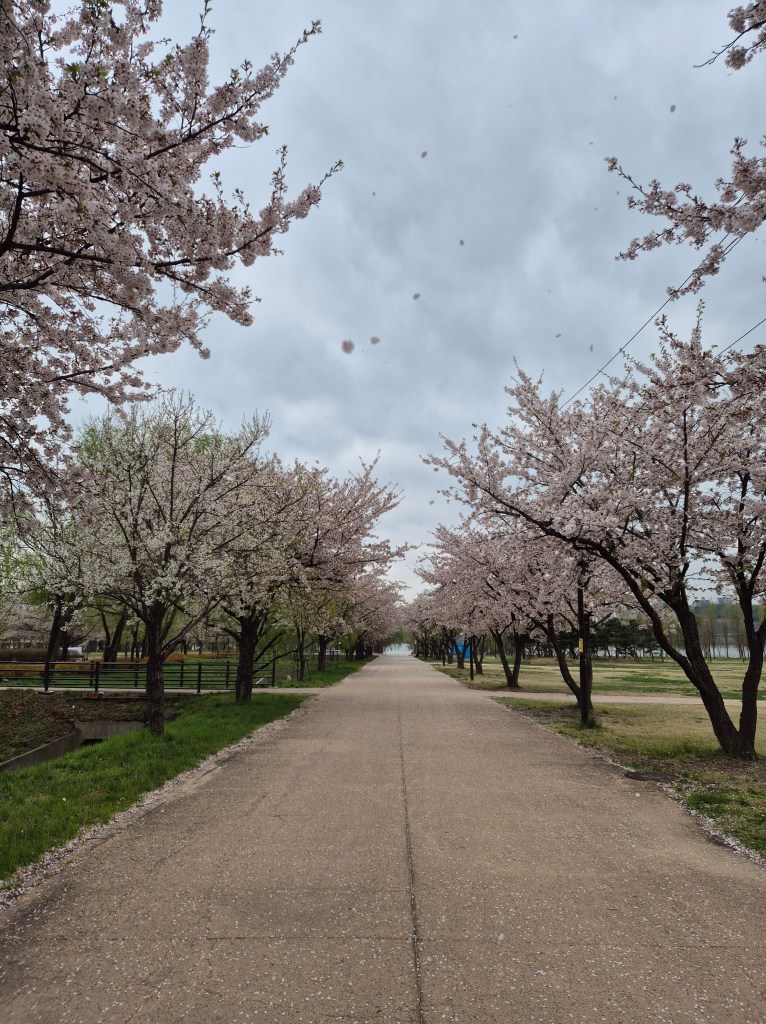
Cherry blossoms along the Han River in Seoul
The last weeks of May and first weeks of April are cherry blossom season in Seoul.

*Lifer: A birdwatching term for a bird you haven’t seen before and thus haven’t added to your life list. E.g., “Oh, look, a great crested grebe. That’s a lifer for me!”

Note: Landmines are a real threat in South Korea, especially around the DMZ, Seoul, and Gyeonggi-do. Since April 2024, North Korea has intensified its efforts to plant mines along the DMZ, without much regard for where the mines end up. These mines are easily dislodged by heavy rainfall and can end up in rivers and streams. North Korea has also been known to use small landmines and to disguise explosive devices to resemble natural objects. When hiking or walking in Korea, it is best to stay on the designated trails and avoid touching or approaching any suspicious objects.


What Makes a Cricketing Legend?

This week, South African batsman Wiaan Mulder sparked debate in the cricketing world when he chose to let legends be legends. In just his sixth innings at number 3 for the Proteas, Mulder blasted 367 runs from just 334 deliveries against Zimbabwe to take the crown for the highest individual score by a South African in test cricket. Mulder looked on track to surpass legends of the game, Mahela Jayawardene, Matthew Hayden, and Brian Lara, to take the number one spot on the list of highest individual test scores and secure status as a legend. But just 33 runs short of Lara’s mammoth 400 not out, Mulder, who was also captaining the side, declared the South African innings.

Mulder later said in an interview that “Brian Lara keeping that record is exactly the way it should be.” And that if he got the chance again, he would “probably do the same thing.” Proteas coach Shukri Conrad apparently also told Mulder to “let the legends keep the really big scores.” This begs the question: What makes a legend, and who gets to be one?

Brian Lara & Wiaan Mulder
Image: SACricketMag
Left: Cricket legend Brian Lara
Right: Proteas batsman Wiaan Mulder

A Missed Opportunity for Mulder

Reactions to Mulder’s declaration have been mixed. Some praised the young batter’s respect for the legends of the game and his selflessness in putting the team first. Many have expressed that breaking the record against a weaker opposition like Zimbabwe wouldn’t hold the same prestige as Lara’s score against an English attack that included names like Andrew Flintoff, Steve Harmison, and Mathew Hoggard. It is worth noting that Lara’s record came in a game that ended in a draw. Mulder’s Proteas beat Zimbabwe with plenty of time left.
Australia’s Mathew Hayden holds the second-highest score with 380, also against Zimbabwe. At the time, this was the world record as Hayden surpassed Brian Lara’s previous record of 375. Nobody ever questions the legitimacy of Hayden’s record, just as I don’t think anyone with any cricketing sense would have questioned Mulder. Scoring 300+ in test cricket is rare. It has only happened 32 times in history, and all the test-playing nations (except new additions Ireland and Afghanistan) have been on the receiving end. As cricket writer Neil Manthorp put it, “To call it a missed opportunity or a once-in-a-lifetime opportunity is not really doing it justice because most of the greatest batters in the history of the game have never had such an opportunity.”  Translation: only legends score triple centuries, and if you get a shot at a big one, you better take it!

The top five highest individual scores in test cricket
Wiaan Mulder claimed fifth place on the list of highest individual scores in a test innings.

The South African Cricketing Mindset

As a die-hard Proteas fan, I think there is more to this. Regardless of the position of the match or the quality of the opposition, there is something to be said for being ruthless in sport. Imagine an Australian batter like Travis Head or Steve Smith were in the same position. Would they have humbly retired their innings and said, “let the legends be the legends”? I doubt it. I don’t think a single Australian batter would have declared before smashing Hayden and Lara’s records and claiming the top spot for themselves. Because Australian cricketers are ruthless. They’re the most successful cricket team of all time, and a key reason for their success is their unconditional pursuit of excellence. They win games because they truly believe they are the best. The South African cricketing mindset is different. Most SA cricketers are humbler and more reserved than their Australian counterparts. The Proteas have had their fair share of tough competitors in Dale Steyn, Mark Boucher, and the ultimate Proteas warrior, Graeme Smith, but for the most part, South African cricketers don’t exude the same confidence and hunger as the Aussies. I believe Mulder had an opportunity to do something great for SA cricket this week, but squandered it.

A month ago, the Proteas pulled off the unthinkable when they beat Australia in the World Test Championship Final. This victory did wonders for South African cricket, especially after multiple experts and pundits wrote them off. Many casual supporters were riveted and watched the entire game. Others who have never been cricket fans and don’t even fully understand the game, rallied behind the Proteas and celebrated their victory like they would a Springbok victory. Then, less than a month later, a young batter, newly promoted to number 3, scores the highest score ever by a South African cricketer. Amazing! Protea Fire! He also breaks the world record for the highest score by any test batsman ever! … Only, he didn’t. He came close, but when it was up for grabs, he respectfully declined. Comparing the Proteas to the Springboks is a tired cliché, but I can’t help but wonder what the reaction would have been if a Springbok team took their foot off the gas against a weaker opponent to preserve a different team’s record. I think it’s safe to say heads would have rolled!

Imagine what it could have done for this young Proteas team’s confidence going into the current WTC cycle with the top dog walking in at number 3. Imagine what it could have done for aspiring young cricketers and fans, knowing that our Wiaan scored the highest total by any batsman ever! Instead, we’re left questioning what makes a legend and who has the right to break records and claim their own legendary status.